

Business Advisory | π 26 August 2026 | β±οΈ 5 min read | Cash Flow & Growth
How Can Singapore SMEs Protect Cash Flow From Rising Costs?
Singapore small businesses are facing renewed cost and cash flow pressures in 2026. This simple guide breaks down the main operational costs and explains how to protect your working capital using practical cash flow strategies and newly enhanced government support.
In this article, we explain:
What is driving up business costs in 2026?
Cash flow is the actual money moving in and out of your bank account. In a high-cost market, even profitable businesses can run out of cash if clients pay late while bills are due immediately. Protecting your daily liquidity is essential to keep operations stable.
Five main cost pressures Singapore small businesses face
Rental costs
Significant fixed expenses, particularly when commercial leases are renewed at higher rates.
Payroll
Scheduled wage requirements (such as the Local Qualifying Salary increase to S$1,800) and a competitive labor market can increase employment costs.
Supplier costs
Global supply-chain disruptions and higher energy and input costs can increase the cost of imported goods, raw materials and logistics.
Utilities
Higher energy tariffs following elevated natural gas prices can increase monthly utility bills.
Financing
Borrowing costs and access to financing can affect an SME's monthly cash commitments, particularly when working capital is tight.
Four practical cash flow protection strategies
1. Build a simple cash flow forecast
- Track cash out: List all fixed bills (rent, salaries, tax) and variable expenses.
- Track cash in: Estimate exactly when customers will pay outstanding invoices.
- Spot the gaps: Compare weekly totals to catch bank balance dips early.
2. Collect customer payments faster
- Review payment terms: Consider shorter terms (such as 14 days) for new customers where appropriate.
- Automate reminders: Set up automated invoice alerts to go out before and on the due date.
- Request deposits: Consider requesting upfront payments (e.g., 30% to 50% depending on the project and industry) to cover initial costs.
3. Practical cost control strategies
- Consolidate vendors: Buy more goods from a single vendor to negotiate bulk discounts.
- Cancel idle software: Audit your monthly subscriptions and prune unused user licenses.
- Lean inventory: Limit on-hand stock to match exact market demand and avoid tying up cash.
4. Build a cash buffer for emergencies
- Aim to build a cash reserve covering several months of essential operating costs.
- Automate savings: Auto-transfer a small percentage (such as 2% to 5%) of weekly revenue to a separate account.
- Treat it as a bill: Make your savings contribution a non-negotiable monthly business expense.
Government funding and grant support
Business Adaptation Grant (BizAdapt)
To help businesses adapt to tariff-related pressures, Enterprise Singapore offers the Business Adaptation Grant (BizAdapt).
- Enhanced Support: From 1 April 2026, support was enhanced to up to 70% for SMEs, with an overall grant cap of S$100,000 per enterprise.
- Scope of Grant: The grant supports eligible enterprises in areas such as trade compliance, legal and contractual matters, supply chain optimisation and market diversification.
- Key Requirement: Eligibility requirements apply, including conditions relating to tariff impact and overseas operations or markets.
EDGE Grant Framework
EDGE will consolidate the EDG, PSG and MRA into a single grant framework from the second half of 2026.
- Unified Support: It will support Singapore businesses, including non-SMEs, up to S$100,000 per year for eligible activities.
- Active Transition: Existing EDG, MRA and PSG applications remain available until EDGE launches.
What Singapore SMEs should do right now
- β Check EFS Eligibility: Confirm you meet the local shareholding requirement of at least 30% held by Citizens/PRs and meet the turnover threshold of S$500 million or less or employment threshold of 200 workers or fewer before contacting banks.
- β Prepare Lender Documentation: Organize updated, clean financial accounts and cash flow projections for standard bank credit assessments.
- β Complete Tax Filings: Ensure your YA 2025 tax return is filed and assessed by IRAS by 31 August 2026 if you rely on the revenue test of S$100 million or less or the sole-prop/partnership NTI test of S$100,000 or less.
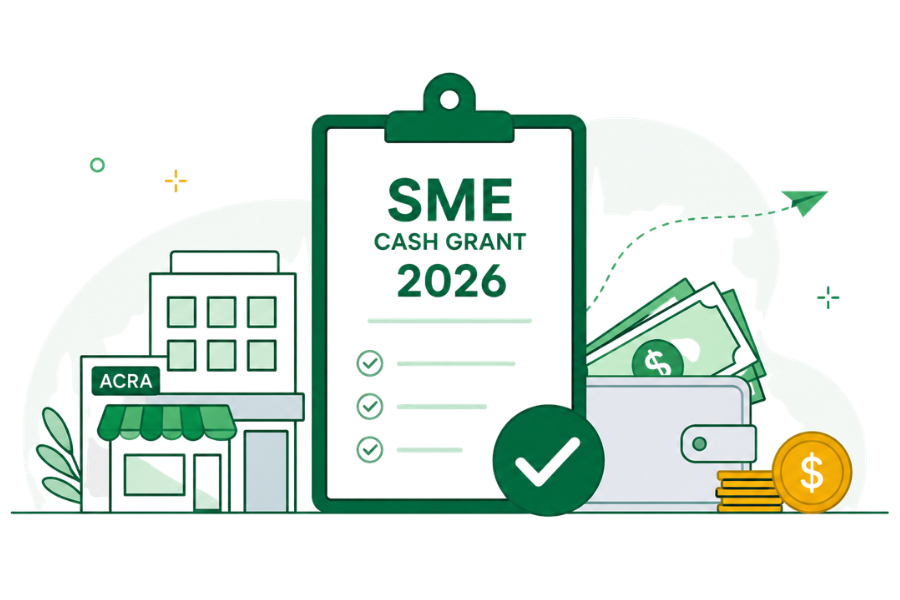
- β Verify with IRAS Checker: Use the online SME Cash Grant 2026 Eligibility Checker on the IRAS portal from mid-October 2026 to confirm your status.
- β Setup Automated Payouts: Confirm your business has an active GIRO arrangement with IRAS or PayNow Corporate linked directly to your UEN (with no suffix).
How Counto helps
To secure government-backed funding and receive automatic grant payouts on time, your financial statements and ACRA filings must remain active and accurate:

- EFS Loan Preparation: We organize clean, bank-ready profit and loss statements and cash flow projections to help you present a strong credit profile to participating banks.
- Deadline Management: We manage your local payroll, CPF calculations, and corporate tax filings, ensuring you meet the timeline requirements for automatic payouts.
- ACRA and tax compliance: We help manage your corporate compliance filings and tax obligations, helping you stay on top of deadlines and avoid unnecessary late fees.
- One Financial Dashboard: Access all your tax schedules, financial records, and filing statuses in real time.